Translate this blog into your language

Showing posts with label Canon announced EOS R5 and EOS R6 cameras and 4 new RF lenses and two Teleconverters. Show all posts

Thursday, February 4, 2021

Canon has exceeded 150 Million interchangeable EF and RF lens milestone


MELVILLE, NY, February 3, 2021 - Canon U.S.A., Inc., a leader in digital imaging solutions, announced today that its parent company, Canon Inc., reached a new lens-manufacturing milestone with the production in January 2021, of the Company’s 150-millionth RF and EF series interchangeable lens for EOS cameras — an RF 70-200mm F2.8 L IS USM telephoto zoom lens (released in November 2019).

Production of interchangeable EF lenses for Canon EOS-series AF (Autofocus) single-lens reflex film cameras began in 1987 at the Company’s Utsunomiya Plant. Over the years, EF lenses have gained support from a wide range of users and production has since expanded to a total of four manufacturing bases, including Canon Inc., Taiwan; Canon Opto (Malaysia) Sdn. Bhd.; and Oita Canon Inc. in southern Japan.

EF lens production passed the 10-million-unit mark in 1995 and crossed the 50-million-unit threshold in 2009. In April 2014, the Company celebrated its first-in-the-world achievement of having manufactured 100 million interchangeable lenses, and now, setting a new world record for the most interchangeable lenses produced, Canon manufactured its 150-millionth RF and EF lens in January 2021. Laid end-to-end, all of the RF and EF lenses Canon has manufactured thus far would measure approximately 7,736 miles in length — nearly equivalent to the Earth’s diameter, which measures approximately 7,917 miles.

Canon’s proprietary EF lenses, launched in March 1987 along with the EOS SLR camera system, have continued to evolve since their introduction, leading the industry through the incorporation of a wide range of innovative technologies, including such world’s firsts as the Ultrasonic Motor (USM), Image Stabilizer (IS) technology, and a multilayered diffractive optical (DO) element.

In 2018, Canon introduced the EOS R system and the RF series lenses, which pursues new heights of quality under the core concept of “Speed, Comfort and High Image Quality.” Today, the Company’s extensive RF and EF lens series lineup currently comprises a total of 118 models, expanding the possibilities for image capture. In addition, thanks to the extensive lineup of lenses, Canon has maintained the number one market share for digital interchangeable-lens cameras since 2003 — a total of 17 years— and in September 2019, the Company celebrated the production of 100 million EOS-series interchangeable-lens cameras.

Canon will continue refining its imaging technologies centered on its RF and EF lens lineup, striving to cater to the varying needs of photographers — from first-time users to advanced amateurs and professionals — while contributing to expanding the photographic and video imaging culture.

Main features, Model name, Release date, and Technologies :

World’s first use of a lens-based Ultrasonic Motor (USM)

EF 300mm f/2.8L USM

Nov. 1987

USM technology delivers fast autofocusing thanks to its high torque and responsiveness. By converting ultrasonic vibrations into rotational energy, the technology makes possible quiet, smooth AF drive performance.

World’s first use of Image Stabilizer (IS) technology

EF 75-300mm f/4-5.6 IS USM

Sept. 1995

Users can see the results of IS technology through the viewfinder. Delivering high precision and stability for superb image stabilization results, this technology expands the possibilities for handheld photography.

World’s first use of a diffractive optical (DO) lens element

EF 400mm f/4 DO IS USM

Dec. 2001

Diffraction is an optical phenomenon in which light waves bend as they pass around the edges of an object. DO lens elements use this phenomenon to correct for a variety of aberrations by controlling the path that light travels.

World’s first use of Subwavelength Structure Coating (SWC)

EF 24mm f/1.4L II USM

Dec. 2008

SWC technology helps to minimize reflections by aligning countless wedge-shaped structures more minute than the wavelength of visible light on the surface of a camera lens.

World’s first use of Hybrid IS, which compensates for both angle camera shake and shift camera shake

EF 100mm f/2.8L Macro IS USM

Oct. 2009

Employing an algorithm, Hybrid IS optimally adjusts for camera shake based on information gathered by two sensors located in the lens. By precisely driving the optical correction system, the technology simultaneously corrects for angle and shift camera shake.

World’s first fisheye lens to deliver both 180-degree diagonal angle of view and 180-degree circular fisheye

EF 8-15mm f/4L Fisheye USM

July 2011

The EF 8-15mm f/4L Fisheye USM enables the capture of images with dramatic deformations, exaggerated perspectives and extreme depths of field, making possible images that are significantly distorted, similar to what a fish might see were it to look skyward from under the water surface.

World’s first super-telephoto zoom lens to employ an internal extender

EF 200-400mm f/4L IS USM Extender 1.4x

May 2013

Featuring a built-in 1.4x extender, the EF 200-400mm f/4L IS USM Extender 1.4x’s zoom range can be expanded with a simple one-touch operation even in locations where users are unable to switch lenses.

World’s first lens offering ultra-wide-angle 11 mm minimum focal length

EF 11-24mm f/4L USM

Feb. 2015

In addition to achieving the world’s widest angle of view starting at a minimum focal length of 11 mm, the EF 11-24mm f/4L USM effectively corrects for aberrations commonly associated with ultra-wide-angle lenses, delivering superb image-quality performance.

World’s first standard zoom lens to deliver f/2 aperture across the entire zoom range

RF 28-70mm F2 L USM

Dec. 2018

Employs a large internal mount diameter and a short back focus to realize an f/2 aperture across the entire zoom range, a feat which was considerably difficult for EF series lenses.

Reference : In pursuit of the ideal lens

The history of lenses for Canon's EOS series of interchangeable-lens cameras began in 1987 with the release of the EOS 650, the world's first autofocus (AF) SLR camera to employ an electronic lens mount, and the EF 35-70mm f/3.5-4.5, EF 35-105mm f/3.5-4.5 and EF 50mm f/1.8 lenses. The EF mount utilized by the camera and lenses not only made possible highly accurate AF, but also anticipated future technological developments including digitalization, high-speed continuous shooting, image stabilization and video recording. This forward-thinking mindset has helped support photographers for more than 30 years.

Amid the transition from film cameras to digital in the 1990s, the adoption of video recording technology for DSLR cameras in the late 2000s and the Company's entry into the video production industry the birth of the Cinema EOS System in 2012, Canon has continued to develop cameras that meet the needs of their time. Throughout this time, Canon has continued to expand the possibilities of photographic expression by producing a rich lineup of EF lenses—including zoom lenses, IS lenses, wide-aperture lenses, macro lenses and tilt-shift lenses—and a number of world-first technologies.

And now, anticipating the next 30 years of social change and technological development, Canon introduced the RF mount alongside its launch of the EOS R system in 2018. In the same year, the EOS R mirrorless camera debuted together with four RF lenses including the RF 24-105mm F4 L IS USM. Leveraging their characteristic large internal mount diameter of 54 mm and a short back focus, RF lenses enjoy greater freedom for lens design that makes possible new levels of high image quality and high performance in compact sizes. To date, a total of 19 RF lens models have been released. Going forward, Canon will continue its mission to expand users' range of photographic expression as it pursues the creation of the ideal lens.

Wednesday, November 4, 2020

Canon announced RF 70-200mm f/4L IS and RF 50mm f/1.8 STM lenses


MELVILLE, N.Y., November 3, 2020 – Canon U.S.A. Inc., a leader in digital imaging solutions, is excited to introduce the compact and lightweight RF70-200mm F4 L IS USM and the RF50mm F1.8 STM, two completely re-designed RF mount lenses with bloodlines to immensely popular EF models that feature new lens formulas and enhanced elements. Canon is also introducing the PIXMA PRO-200 printer, which is ideal for photography students and graphic designers.

“As Canon began to further build out the company’s RF lens portfolio, the goal in mind was to create advanced lenses, for a variety of experience levels, that also featured a sense of familiarity for longtime Canon users,” said Tatsuro “Tony” Kano, executive vice president and general manager of Canon U.S.A.’s Imaging Technologies & Communications Group. “Canon prides itself on being able to uniquely offer both input and output solutions to our customers. We are equally excited to see the images captured with the new lenses, and the prints that are to be created with the new PIXMA PRO-200 printer.”


Canon RF 70-200mm F4 L IS USM Lens

The Canon RF70-200mm F4 L IS USM lens is ideal for photography enthusiasts ranging from advanced amateur to professional skill levels. The compact and lightweight nature of the lens makes it Canon’s shortest and lightest 70-200mm F4 zoom lens to date. This RF lens is approximately 32 percent shorter and 11 percent lighter than its EF counterpart with a large portion of the lens element arrangement closer to the camera body. This arrangement is designed to provide photographers with a more balanced feel and experience even at the zoom range’s telephoto end. Additionally, the shorter and lighter design allows the lens to more easily be stowed away in a camera bag when not in use.

The RF70-200mm F4 L IS USM features two independent Nano USM motors, providing an even greater level of high-speed autofocus for still image shooting as well as quiet and smooth autofocus for video shooting. The lens also incorporates a floating focus control that drives the two lens groups individually while using the two aforementioned Nano USM motors. The floating focus lens element shortens the focusing distance and helps reduce breathing, providing users with fast, consistent and reliable performance.


Additional Features of The Canon RF70-200mm F4 L IS USM Lens Include :

  • 16 lens elements in 11 groups, including four UD lenses, that help to reduce chromatic aberration
  • Optical Image Stabilizer with up to 5 Stops[i] of shake correction
  • Up to 7.5 stops[ii] of shake correction with coordinated control of Optical Image Stabilizer and In-Body Image Stabilizer
  • Three stabilizer modes
  • Customizable control ring that allows photographers to adjust exposure compensation, shutter speed, aperture, or ISO
  • 12-pin communication system
  • L-Series dust and weather-resistant build with a fluorine coating
  • Minimum focusing distance of 1.97 feet and a maximum magnification of 0.28x
  • Air Sphere Coating (ASC) that helps minimize lens flare and ghosting


Canon RF 50mm F1.8 STM Lens

Creatives love using a 50mm lens because that focal length is similar to the natural viewpoint of the human field of vision. This perspective allows for the lens to be used in a wide variety of shooting situations, including portraits, landscapes and food photography. What’s more, Canon 50mm f/1.8 lenses have long been a popular tool for both photographers and creators due to their budget-friendly price point, extremely compact and lightweight form factor, and versatility.

The tradition continues with the RF50mm F1.8 STM that, in many ways, is improved over its EF counterpart. The first visually noticeable improvement is the customizable control ring that has become synonymous with RF lenses. The control ring allows photographers to adjust exposure compensation, shutter speed, aperture, or ISO and with a flip of the side switch can adjust focus. The inclusion of a PMo aspherical lens helps to reduce chromatic aberration and provides high-image quality even at the periphery of the image. Additionally, the combination of the lens shape and Super Spectra Coating (SSC) helps to minimize ghosting and flaring.


Additional Features of The Canon RF 50mm F1.8 STM Lens Include :

  • Six lens elements in five groups
  • 12-pin communication system
  • Minimum focusing distance of 0.98ft and a maximum magnification of 0.25x
  • Up to 7 stops[iii] of Shake Correction with EOS R Series cameras with In-Body Image Stabilizer

Wednesday, September 9, 2020

Canon EOS R5 camera firmware version 1.1.1 available for download


Canon EOS R5 camera firmware update version 1.1.1 is now available for download. New improvements for the RF 100-500mm f/4.5-7.1 L IS USM lens is added.

Firmware Version 1.1.1 incorporates the following fixes and enhancements :

  • When the RF100-500mm F4.5-7.1 L IS USM lens is attached, an image stabilization effect of approximately six stops is achieved through collaborative control with the in-lens image stabilization.
  • Fixes a phenomenon in which the IS capabilities may be degraded when performing continuous shooting in cases where the RF100-500mm F4.5-7.1 L IS USM lens is attached to the EOS R5 running firmware version 1.1.0.

Canon EOS R6 camera firmware version 1.1.1 available for download


Canon EOS R6 firmware update version 1.1.1 is now available for download

Firmware Version 1.1.1 incorporates the following fixes and enhancements :

  • A messaging is displayed when [HDMI display: Camera+External monitor] and [Overheat control: on] settings are both enabled.
  • When the RF100-500mm F4.5-7.1 L IS USM is attached, an image stabilization effect of approximately six stops is achieved through collaborative control with the in-lens image stabilization.
  • Fixes a phenomenon in which the IS capabilities may be degraded when performing continuous shooting in cases where the RF100-500mm F4.5-7.1 L IS USM lens is attached to the EOS R6 running firmware version 1.1.0.
  • When using certain RF lenses for movie shooting, the in-lens image stabilization mechanism has been improved.
  • Fixes a phenomenon in which the "Slow Synchro" setting screen is not accurately displayed, when the language is set to English.
  • Fixes a typo displayed on the communication setting screen, when the language is set to Korean.
  • Connectivity during FTP transmission has been improved.
  • Temperature detection and shooting time control in video shooting have been improved. In addition, the total shooting time when the short-time recording and power-on/off are performed repeatedly at room temperature is improved.
  • The phenomenon in which the movie recording time available is not correctly displayed when the Date/Time/Zone is not set has been corrected.

Tuesday, August 4, 2020

New Canon Firmware Updates for EOS-R, EOS-Ra, EOS-RP cameras RF and EF lenses


Canon has announced a slew of Firmware Updates for EOS R, EOS Ra, EOS RP cameras, RF Lenses, and two EF Super Telephoto lenses.

Canon EOS R firmware version 1.7.0 — Download

Canon EOS Ra firmware version 1.5.0 — Download

New Firmware Version 1.7.0 and 1.5.0 incorporate the following enhancements :

1. Support has been added for the following lenses :

  • RF 600mm F11 IS STM
  • RF 800mm F11 IS STM
  • Extender RF 1.4x
  • Extender RF 2.0x

2. The operation of playing back through the multi-function bar has been improved (please refer to the latest version of the camera's Instruction Manual that is released with the firmware update).

3. Support for the Battery Pack LP-E6NH has been added.

Canon EOS RP firmware version 1.5.0 — Download

Firmware Version 1.5.0 incorporates the following enhancements :

Support has been added for the following lenses :

  • RF 600mm F11 IS STM
  • RF 800mm F11 IS STM
  • Extender RF 1.4x
  • Extender RF 2x

 Lens firmware updates incorporate the following enhancement :

The lens-based image stabilizer function works together with the camera-based image stabilizer function to achieve greater image stabilization effects with EOS R5/EOS R6.

Canon RF 15-35mm f/2.8 L IS USM Lens - Firmware version 1.0.7

Canon RF 24-70mm f/2.8 L IS USM Lens - Firmware version 1.0.7

Canon RF 24-105mm f/4L IS USM Lens - Firmware version 2.0.6

Canon RF 24-105mm f/4-7.1 IS STM Lens - Firmware version 2.0.4

Canon RF 24-240mm f/4-6.3 IS USM Lens - Firmware version 1.0.6

Canon RF 70-200mm f/2.8 L IS USM Lens - Firmware version 1.0.8

Canon RF 35mm f/1.8mm f/1.8 IS STM Macro Lens - Firmware version 2.0.2


The following lens firmware updates incorporate the following enhancement :

Focusing performance has been improved when using the Servo AF continuous shooting mode.

Canon EF 400mm f/2.8L IS III USM Lens — Firmware version 1.1.3

Canon EF 600mm f/4L IS III USM Lens — Firmware version 2.0.2

A complete hands-on review of Canon EOS R5 full frame mirrorless camera


Sunday, July 26, 2020

Canon EOS R5 camera 8K video real world testing


Canon announced the EOS R5 and EOS R6 full frame mirrorless cameras on July 9, 2020. Here are a couple of real world 8K video tests of the EOS R5's capabilities.


Wednesday, July 22, 2020

Canon EOS R5 camera's Animal Eye AF is a Game Changer for Wildlife Photography


Canon announced the EOS R5 and EOS R6 full frame mirrorless cameras on July 9, 2020. Here are some sample photos taken with the EOS R6. Many of you know why I am not interested in acquiring either the EOS R5 or EOS R6 at this time. My main and backup bodies are the EOS-1D X Mark III and EOS-1D X Mark II.

My readers know me as the Wildlife Ho-tographer. You can follow my travels on FacebookTwitterInstagram and see my equipment bag and works on MichaelDanielHo.com
When the EOS R1 debuts next year, I may be interested in acquiring one. 

The semi-pro EOS-R5 mirrorless camera is a great improvement over the EOS R. Its phenomenal Animal Eye Auto Focusing feature is especially useful for wildlife photography but I am still not ready to buy an EOS R mirrorless camera yet.


Friday, July 17, 2020

Canon EOS R7 APS-C mirrorless camera (EOS-7D Mark II replacement) coming?


Canon announced the EOS R5 and EOS R6 full frame mirrorless cameras on July 9, 2020. Here are some sample photos taken with the EOS R6. My readers know why I am not interested in acquiring either the EOS R5 or EOS R6. My main and backup bodies are the EOS-1D X Mark III and EOS-1D X Mark II.

However, there is a real possibility Canon may offer an APS-C version of the EOS R6, possibly called the EOS R7, to replace the EOS-7D Mark II DSLR, some time late 2020 or in Q1 of 2021. I will be interested in acquiring this body and of course, when the EOS R1 arrives some time in 2021, assuming the global pandemic will be under control and the Tokyo Olympics takes place in July 2021.

First hands on review of Canon EOS R6 full frame mirrorless camera


Canon announced the EOS R5 and EOS R6 full frame mirrorless cameras on July 9, 2020. Here are some sample photos taken with the EOS R6.


Tuesday, July 14, 2020

First look at Canon RF 600mm f/11 and RF 800mm f/11 DO lenses for wildlife photography


Canon RF 600mm and RF 800mm DO lenses


See how Canon EOS R5 camera's Animal AF works in the real world


Canon issued details regarding EOS R5 and EOS R6 overheating during video recording


Details Regarding Canon EOS R5/EOS R6 Overheating During Video Recording

The EOS R5, one of the latest additions to Canon’s full-frame mirrorless camera line, offers class-leading autofocus with high-resolution and high frame rate video recording options using the maximum width of the full-frame sensor at high bit rates. Inevitably, this combination of features has potential to generate some significant heat, which will limit recording time.

Canon has taken several steps to manage the potential for overheating, including:
Magnesium alloy was used in the body to dissipate heat away from internal components
An “overheat control” function to reduce heat generation when the camera is in standby
In regard to the installation of a fan: The decision not to install a fan within the body was made in order to maintain the EOS R5’s compact size, lightweight construction and weather resistance.

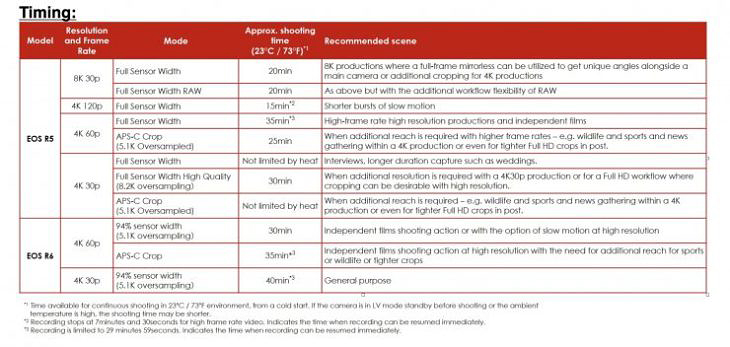
Before recording starts, the EOS R5 and EOS R6 display an estimate of the recordable time based on the current camera temperature and the set recording mode.

Canon has published and included below the approximate recording and estimated recovery times for 23°C / 73°F environments and ensure that the camera will warn users when it is getting too hot. Additionally, tips to reduce overheating as well as recovering time are listed below.

Timing :


How can you reduce heat buildup in the EOS R5?

Set Overheat Control function to "ON" (default). When the overheat control function is enabled, the movie size and frame rate are automatically changed while the camera is in standby mode to suppress the rise of the internal temperature.

Between recordings, it is recommended to turn off the camera and position the camera out of direct sunlight. Use an external fan to dissipate heat.

How long will it take for the camera to recover?

Estimated camera recovery times are indicated below. The time until full record time is available will vary with ambient temperature, continued camera operation and the selected shooting resolution.


What about the EOS R6?

Like the EOS R5, the EOS R6 offers powerful movie recording and stills capabilities within a compact body design. At the highest frame rates and resolutions heat is inevitably generated. We believe the EOS R6 offers best in class performance, especially for enthusiast photographers and video content creators.

The EOS R6 can record up to the 29 minutes 59 second recording limit in the 5.1K oversampled 4K 60p mode at (23°C / 73°F) before encountering any heat related issues within the camera and up to 40 minutes of 4K at 30p.

Thursday, July 9, 2020

Canon announced EOS R5 and EOS R6 cameras and 4 new RF lenses and two Teleconverters


MELVILLE, N.Y., July 9, 2020 – With anticipation at a fever pitch, Canon U.S.A. Inc., a leader in digital imaging solutions, is excited to introduce the company’s next generation of full-frame mirrorless cameras – the EOS R5 and EOS R6. These groundbreaking cameras are the result of many years of collecting and listening to feedback from Canon users and are sure to meet the needs and demands of a variety of creators. The EOS R5 is a camera designed for professional applications featuring a new 45-megapixel full-frame CMOS sensor and uncropped 8K video recording up to 29.97 fps.

The EOS R6 is geared towards advanced amateurs featuring a 20.1-megapixel full-frame CMOS sensor and 4K video recording up to 59.94 fps. The addition of the EOS R5 and the EOS R6 cameras within the EOS R series lineup further solidifies Canon’s commitment to providing the equipment needed for users to bring their content to the next level.

Canon is also introducing four RF lenses and two RF lens extenders: The Canon RF 100-500mm F4.5-7.1 L IS USM, Canon RF 600mm F11 IS STM, Canon RF 800mm F11 IS STM, and RF 85mm F2 MACRO IS STM lenses. All four new lenses were designed to meet the ever-expanding demands of the skilled creatives who capture amazing imagery using EOS R series cameras, including the new EOS R5 and EOS R6. In addition to the lenses, there are two new RF lens extenders, a 1.4x and a 2x model, allowing for users to take their compatible RF lens focal lengths even farther, and a 13-inch professional printer, the imagePROGRAF PRO-300, to bring photos to life through the power of print.

“For all of the Canon research and development team members who worked tirelessly on the production of these new products, today marks the culmination of a long journey. For those people looking for the next great tools to work with to expand their creative possibilities, the door is now wide open,” said Tatsuro “Tony” Kano, Executive Vice President and General Manager of Canon U.S.A.’s Imaging Technologies & Communications Group. “The industry has asked for new products that can push their levels of creativity to new heights, and we are confident that the EOS R5 and EOS R6, alongside the new lenses, lens extenders, and the pro printer, will fulfill those needs and more.”

Canon EOS R5 and EOS R6

Both the EOS R5 and EOS R6 cameras have the ability to capture the action of a variety of fast-moving subjects with impressive accuracy and speed. When using the mechanical shutter, each can shoot up to 12 fps and up to 20 fps when using the completely silent shutter. Both cameras are the first to be outfitted with Canon’s advanced Dual Pixel CMOS AF II which utilizes up to approximately100 percent coverage of the AF area and EOS iTR AF X incorporating AF tracking algorithms using deep learning technology and enhanced readout speed of the CMOS sensor and processing speed thanks to the DIGIC X image processor.

The 1,053 automatically selected AF Zones are made even more potent by the ability to detect the human eye, face or head as well as the eye, face or body of animals such as dogs, cats and even birds. Adding to the feature set is the 5-axis In-Body Image Stabilizer, having coordinated control with Optical Image Stabilizer in IS equipped RF lenses. This provides up to 8 stops of shake correction, a feature that many creators have long asked for from Canon. Both the EOS R5 and R6 cameras come with a new LP-E6NH battery with a higher capacity than the previous model.

As the new flagship model in the EOS R series lineup, the EOS R5 camera has features that pack a punch for a variety of users who create both still and video content. It has a powerful 45-megapixel full-frame CMOS sensor and is driven by the speedy DIGIC X image processor, giving wide dynamic range as well as boasting an ISO range of 100-51,200 that is expandable up to 102,400. In a camera full of eye-popping features, one that really stands out is the ability to record uncropped 8K RAW internal video recording up to 29.97 fps and 8K internal video recording up to 29.97 fps in 4:2:2 10-bit Canon Log (H.265)/4:2:2 10-bit HDR PQ (H.265).

The camera can also record 4K internal video recording up to 119.88 fps in 4:2:2 10-bit Canon Log (H.265)/4:2:2 10-bit HDR PQ (H.265). External recording in 4K is also available up to 59.94 fps. When in DCI modes, the 8K and 4K video recording is uncropped and Dual Pixel CMOS AF II is available in all 8K and 4K recording modes.

Additional features of the EOS R5 camera include :

  • Dual-card slots: 1x CFexpress and 1x SD UHS-II
  • Built-in 0.5-inch OLED EVF with approximately 5.76 million dots and a 119.88 fps refresh rate
  • 3.2-inch 2.1 million dots vari-angle LCD touch screen
  • 5GHz/2.4GHz Built-in Wi-Fi® and Bluetooth Technology with the ability to utilize the image.canon application, as well as optional WFT-R10A wireless file transmitter with Ethernet support
  • Enhanced operating controls such as rear-dial, multi-controller • The ability to voice tag photos and videos
  • Weather, drip and dust sealing on par with the EOS 5D series

The EOS R6 camera is well-equipped with a host of new features to push the limits of creativity for imaging enthusiasts. The combination of the EOS-1D X Mark III based 20.1-megapixel full-frame CMOS sensor and the DIGIC X image processor produces an ISO range of 100-102,400 and is expandable to 204,800. Internal video recording at 4K is capable up to 59.94 fps or 1080p up to 119.88 fps in 10 bit 4:2:2 Canon Log(H.265) or HDR PQ(H.265). The camera also features a built-in 0.5-inch OLED EVF with approximately 3.69 million dots and a 119.88 fps refresh ratevi.

Additional features of the EOS R6 camera include :

  • Dual UHS-II SD card slots
  • 3-inch 1.62 million dots vari-angle LCD touch screen
  • 2.4GHz Built-in Wi-Fi®vii and Bluetooth Technologyviii with the ability to utilize the image.canon application
  • Enhanced operating controls such as rear-dial, multi-controller
  • Weather, drip and dust sealing on par with the EOS 6D series

Battery Accessory

The optional BG-R10 battery grip accessory will be available for both the EOS R5 and EOS R6 full-frame mirrorless cameras. The BG-R10 accommodates up to two batteries and is compatible with the new LP-E6NH, LP-E6N and LP-E6 batteries. The convenient BG-R10 grip accessory can also improve handling for users while capturing portrait photography.

Canon RF100-500mm F4.5-7.1 L IS USM

The Canon RF100-500mm F4.5-7.1 L IS USM is a high-performance and versatile super-telephoto zoom lens that will find its way into the bags of many photographers. The compact and lightweight lens features optical image stabilization of up to five stops* of shake correction with three different IS modes, including standard, panning and during exposure only. Two Nano USM motors are at the heart of this lens and provide users with high-speed, smooth and quiet auto focus with a minimum focusing distance of three feet.

Additional features of the Canon RF100-500mm F4.5-7.1 L IS USM include :

  • Rotation-Type zoom ring and torque adjustment allows for precision control and feel
  • Customizable control ring that enables photographers to adjust exposure compensation, shutter speed, aperture or ISO
  • 12-pin Communication System
  • Canon L-Series grade dust and weather-resistant construction with a fluorine coating
  • Lens hood with side window allows specialty filters to be adjusted even while Lens Hood is attached
  • Compatible with the new 1.4x and 2x RF lens extenders (from 300 to 500mm focal length)

Canon RF600mm and 800mm F11 IS STM

The Canon RF600mm and RF800mm F11 IS STM lenses are the first fixed focal length super-telephoto RF lenses and are incredibly compact and lightweight. The portability of the new lenses is made even greater due to the ability for the lens barrel to retract and lock in place when the lenses are stowed away and not in use. Diffractive Optics technology helps to reduce the necessary number of lenses and greatly diminish the cost of the lenses, making them affordable for a broader group of photographers.

Additional features of the Canon RF600mm and RF800mm F11 IS STM lenses include :

  • Lightweight – the RF600mm weighs approximately 2.05lb and the RF800mm weighs approximately 2.78lb, respectively
  • Compact size, RF600mm measures approximately 7.85inch and RF800mm with measures approximately 11.09inch when retracted, respectively
  • Fixed f/11 aperture
  • Optical image stabilization of five stops* for the RF600mm and four stops* for the RF800mm of Shake Correction
  • Lead screw-type STM enables smooth auto focusing for still-image and video shooting
  • Customizable control ring that allows photographers to adjust exposure compensation, shutter speed, aperture or ISO
  • 12-pin Communication System
  • Compatible with the new 1.4x and 2x RF lens extenders

Canon RF85mm F2 MACRO IS STM

The third RF85mm lens in the RF lineup, the Canon RF85mm F2 MACRO IS STM is compact and lightweight, featuring a bright f/2 aperture helping to capture images that have exceptional bokeh. The lens features a maximum magnification of 0.5x and a minimum focusing distance of 1.15 feet, providing users with macro-photography capability.

Additional features of the Canon RF85mm F2 MACRO IS STM include :

  • Optical Image Stabilization with up to five stops* of Shake Correction
  • Hybrid IS compensates for angular and shift camera shake during macro photography
  • Control Ring for Direct Setting Changes.
  • 12-pin Communication System
  • Nine blade Circular Aperture

RF Lens Extenders

Lens extenders have long been a practical and useful tool for a variety of photographers. That story continues with the introduction of the Extender RF 1.4x and Extender RF 2x. The new lens extenders inherit the same high image quality, precision AF and reliability, such as being drip and dustproof, of EF lens extenders. When used in combination with the newly-released compatible lenses, the capturing range can be dramatically increased, providing consumers with additional use cases for their existing RF lenses.

Canon imagePROGRAF PRO-300

Completing the lineup of professional printer options from 13 inches through 60 inches, Canon also unveiled today the new 13-inch Canon imagePROGRAF PRO-300 Inkjet Printer along with a new Premium Fine Art Rough paper. Providing an improved workflow and high-quality output within a smaller footprint compared to previous models, this new printer excels at professional printing performance. Combined with the new Premium Fine Art Rough paper that features a textured surface to express the depth of an image, the printer along with the paper and new EOS R5 or EOS R6 camera introduces a new powerhouse professional imaging trio that meets creators’ demands.

Pricing and Availability

The EOS R5 full-frame mirrorless camera is scheduled to be available at the end of July for an estimated retail price of $3899.00 for the body only and $4999.00 for the R5 and RF 24-105mm F4 L IS USM lens kit**.

The EOS R6 full-frame mirrorless camera is scheduled to be available at the end of August for an estimated retail price of $2499.00 for the body only, $2.899.00 for the R6 and RF 24-105 F4-7.1 IS STM lens kit or $3,599.00 for the R6 and RF 24-105mm F4 L IS USM lens kit**.

The BG-R10 battery grip accessory and WFT-R10A are both scheduled to be available at the end of July for an estimated retail price of $349.99 and $999.99**, respectively.

The RF100-500mm F4.5-7.1 L IS USM lens is scheduled to be available in September 2020 for an estimated retail price of $2,699.00. The RF600mm F11 IS STM and RF800mm F11 IS STM lenses are scheduled to be available at the end of July 2020 for an estimated retail price of $699.99 and $899.99, respectively. The RF85mm F2 MACRO IS STM lens is scheduled to be available in October 2020 for an estimated retail price of $599.99 **.

The RF Extender 1.4x and 2x are scheduled to be available at the end of July for an estimated retail price of $499.99 and $599.99** each.

The imagePROGRAF PRO-300 Printer will be available later in July for a suggested retail price of $899.99. Premium Fine Art Rough paper will also be available later in July for a suggested retail price of $44.99 for Letter size, $109.99 for 13” x 19” inches and $169.99, 17” x 22” inches**.

For more information please visit, www.usa.canon.com/virtualproductlaunch